Cut
Curtain haircut
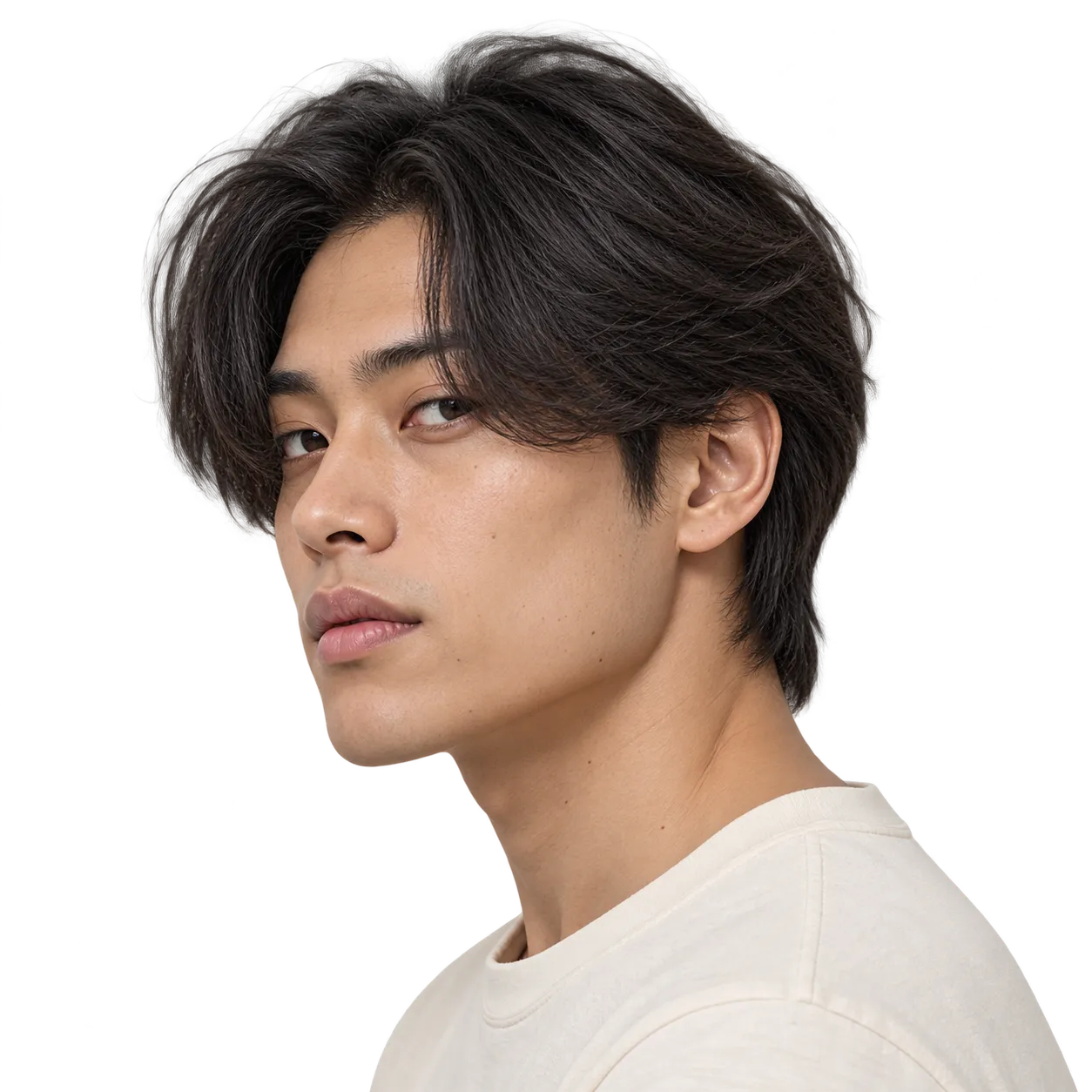
The curtain haircut is defined by its split front silhouette: longer hair is parted through the center or close to it and falls to either side of the forehead.
Classic versions commonly keep enough length around the front and sides to reach roughly ear level, while modern versions range from sleek and controlled to softer, more textured interpretations.
The haircut is especially recognizable on straight and wavy hair, where the two front sections can form the characteristic loose C-shaped sweep.
Style notes
- Hair Type Compatibility
- 1A1B1C2A2B2C3A3B3C4A4B4C
Estimates describe how closely defining features can be achieved with ordinary cutting and styling while preserving the natural curl pattern, assuming sufficient length. They are not personal suitability scores, promises, or eligibility guidance. Each segment is labeled for screen readers with its subtype and resolved score.
Examples
MoreVariations
Choose the details
Classic curtains
Medium-length hair with a clear center part and smooth front sections falling symmetrically to either side.
Curly curtains
A curl-specific interpretation that preserves the center split and face-framing front while allowing the hair to form a fuller rounded silhouette.
Textured curtains
A looser version with more separation, movement and visible natural texture through the front and crown.
Agree on front length, part position, side length and how strongly the hair should sweep away from the face before cutting.
- Should the part sit exactly in the center or slightly off-center?
- Where should the front sections finish when dry: eyebrow, cheekbone, ear or lower?
- Should the sides remain full around the ears or be tapered shorter?
- Do you want a sleek classic finish or more natural texture and separation?
- How much daily styling are you willing to do to maintain volume and the outward sweep?
“I’d like medium-length curtains with a clean center part, enough length in front to sweep toward my cheekbones, full sides around the ears, and a soft natural bend rather than a hard-styled finish.”
What changes the result
Bring these variables
- The style needs sufficient front length for the hair to divide and fall to both sides of the face.
- Very straight or fine hair may need blow-drying or light styling product to create lift and an outward bend instead of lying flat.
- Natural waves can create the curtain movement with less styling, while stronger curls increasingly produce a curl-specific interpretation rather than the sleek classic silhouette.
- Density affects how exposed the center part appears and how much volume the two front sections can hold.
Sources reviewed
This Iconic ‘90s Look For Men Is Making A Serious Comeback On Tik Tok · Hair.com by L'Oréal · reviewed
1B Hair: What Is It and How to Care For It · Hair.com by L'Oréal · reviewed