Cut
French crop
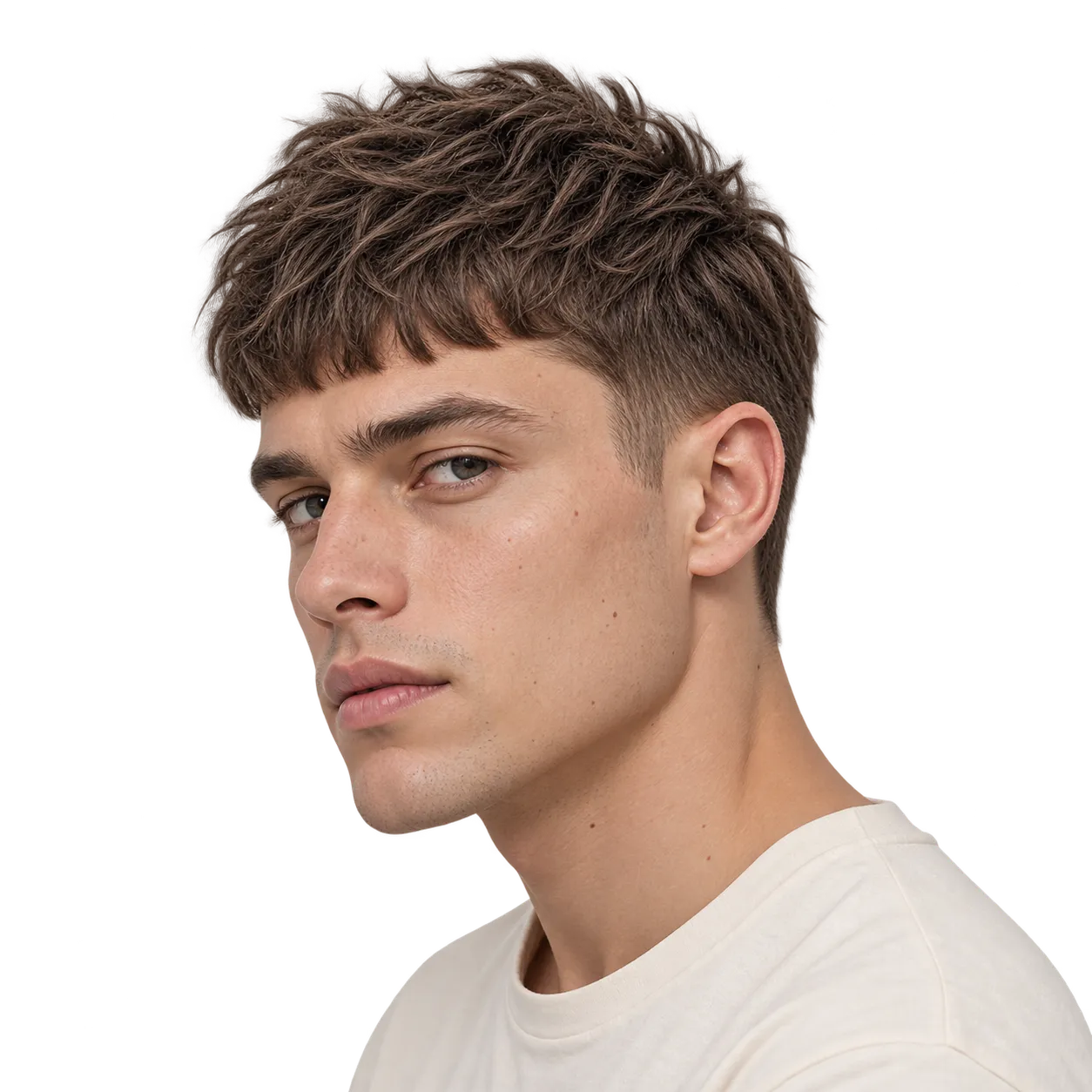
The French crop is defined less by a particular fade and more by the relationship between its compact sides, textured top and forward-facing fringe.
Classic versions keep the fringe short and relatively blunt, while modern versions often break up the edge with texture for a softer, less geometric finish.
The top normally stays short enough to remain compact but long enough to show texture and direction rather than reading as a uniform buzz cut.
Style notes
- Hair Type Compatibility
- 1A1B1C2A2B2C3A3B3C4A4B4C
Estimates describe how closely defining features can be achieved with ordinary cutting and styling while preserving the natural curl pattern, assuming sufficient length. They are not personal suitability scores, promises, or eligibility guidance. Each segment is labeled for screen readers with its subtype and resolved score.
Examples
MoreVariations
Choose the details
Classic French crop
Short back and sides with a compact textured top and a short, relatively straight fringe worn forward.
Curly French crop
Adapts the compact crop and forward fringe to naturally curly hair, producing a fuller and less linear front edge.
Textured French crop
Uses more separation and irregularity through the top and fringe while preserving the forward direction.
The main choices are fringe length and shape, top texture, side length, and whether the sides should be simply short, tapered, or faded.
- How short should the fringe sit on the forehead?
- Should the fringe edge look blunt and graphic or broken and textured?
- How much length should remain on top for texture?
- Should the sides and back be clipper-short, tapered, or faded?
- Do you want a compact natural finish or stronger separation through the top?
“I’d like a textured French crop with a short broken fringe pushed forward, about a few centimeters of texture on top, and short natural sides without taking the fade down to skin.”
What changes the result
Bring these variables
- The forward fringe is a defining feature; without it, the result may read as a generic textured crop.
- Very straight hair may need texturizing and matte product to keep the top from appearing flat or helmet-like.
- Wavy hair naturally creates separation and movement through the short top.
- Curly hair can support the same cut geometry, but stronger curl patterns soften the straight horizontal character of the classic fringe.
- The haircut does not inherently require a skin fade; keeping the sides simply short or softly tapered can preserve a more balanced, less fade-dominant silhouette.
Sources reviewed
The Trendiest Classic Hairstyles For Men To Try · Hair.com by L'Oréal · reviewed
18 Trending Low Maintenance Haircuts For Men · Hair.com by L'Oréal · reviewed
Get the Perfect Barber Haircut: How to Talk to Your Barber · Men's Health · reviewed
The 10 Best Summer Hairstyles for Men · Men's Health · reviewed