Cut
Natural afro
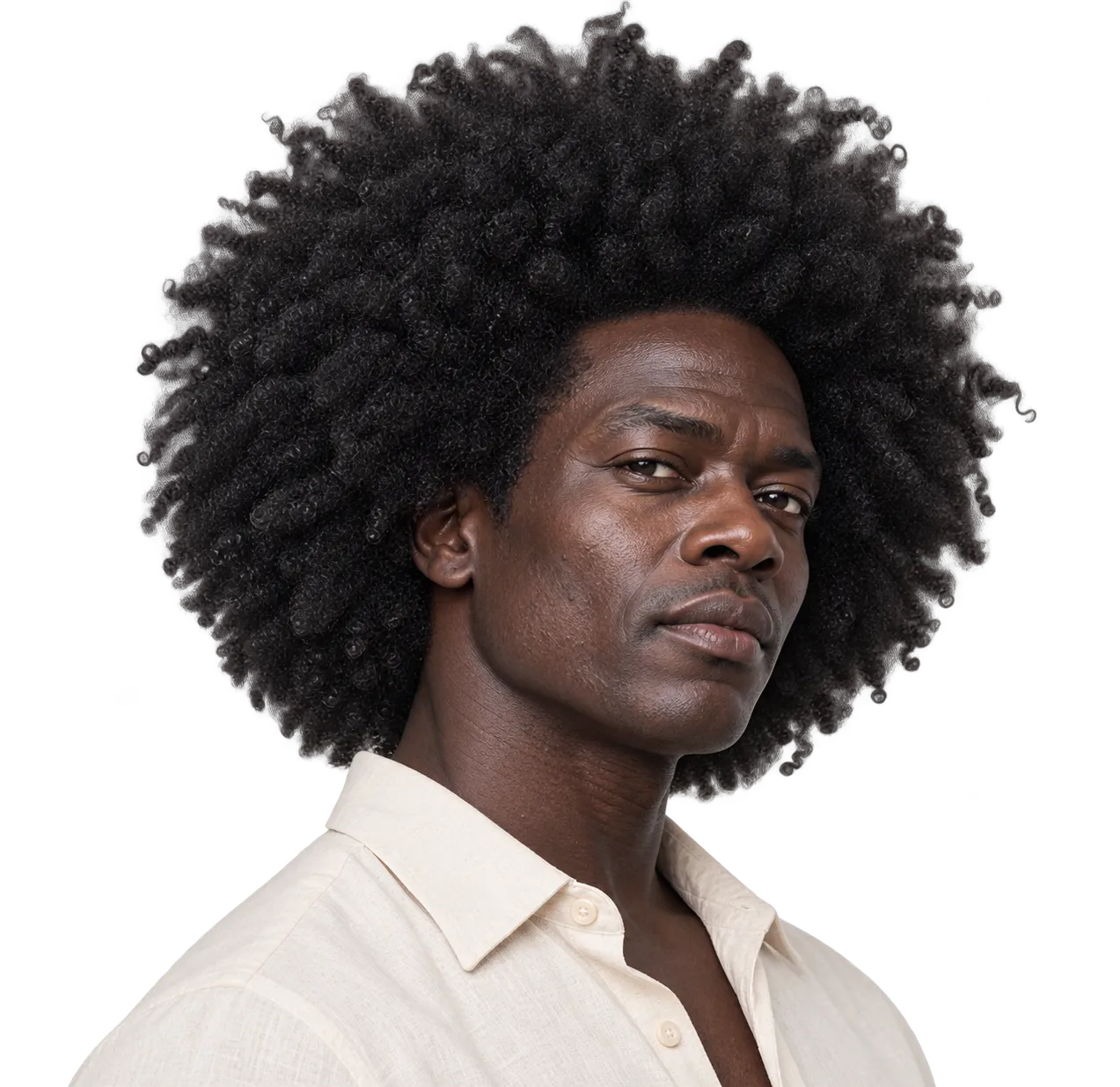
The natural afro uses the hair's own curl or coil structure to create substantial volume around the head rather than relying on straightening or a tightly controlled geometric outline.
Its silhouette is usually broadly rounded, but the perimeter can remain organic: individual curl clusters, slight asymmetry and natural variation in density are compatible with the look.
Afros became especially visible during the natural-hair and Black-is-Beautiful movements of the 1960s and 1970s, when wearing Black hair in its natural texture acquired strong cultural and political significance.
Afro picks and other wide-toothed tools can lift hair away from the scalp and increase volume while keeping the natural texture present. The result does not need to be trimmed into the near-perfect sphere associated with a more heavily sculpted Afro.
Style notes
- Hair Type Compatibility
- 1A1B1C2A2B2C3A3B3C4A4B4C
Estimates describe how closely defining features can be achieved with ordinary cutting and styling while preserving the natural curl pattern, assuming sufficient length. They are not personal suitability scores, promises, or eligibility guidance. Each segment is labeled for screen readers with its subtype and resolved score.
Examples
More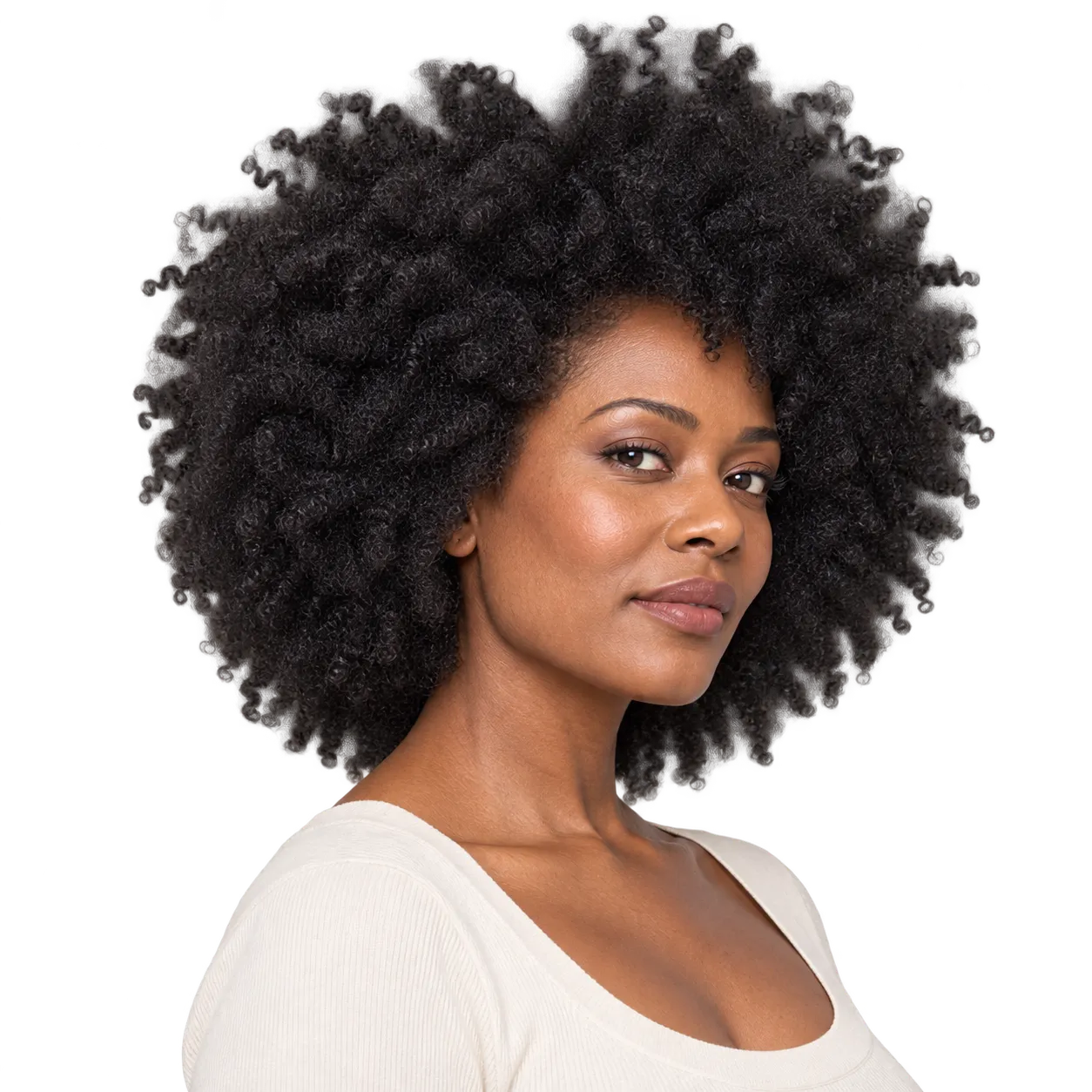
Variations
Choose the details
Full-volume natural afro
Uses greater retained length and picking for a larger silhouette without forcing the perimeter into a precise geometric sphere.
Soft rounded natural afro
Creates a broadly rounded silhouette while preserving visible texture, natural perimeter variation and moderate asymmetry.
Agree on overall size, how much natural irregularity to preserve, and whether the perimeter should be lightly shaped or allowed to follow the hair's natural distribution.
- How large do you want the finished Afro to appear relative to your head and shoulders?
- Should the outline be softly rounded or intentionally left more irregular and organic?
- How much length do you want to retain through the crown, sides and lower perimeter?
- Do you want the curl or coil clusters to remain visibly defined, or should the hair be picked out more fully for volume?
- Should the stylist correct noticeable asymmetry or preserve more of the natural growth pattern?
“I want a full natural Afro with a soft rounded shape, but not a perfectly sculpted sphere. Keep the natural texture visible, retain plenty of volume, and only refine the perimeter enough that the overall silhouette feels intentional.”
What changes the result
Bring these variables
- This style prioritizes natural texture and volume over a mathematically controlled outline, so some perimeter irregularity is part of the intended result.
- Picking increases volume and can reduce the visual definition of individual curls or coils, so the desired balance between definition and expansion should be discussed.
- Shrinkage can substantially change the apparent length and diameter of the finished Afro, so shaping should be assessed on dry hair in its intended worn state.
- Greater density and tighter curl or coil patterns generally make it easier to support a large self-sustaining silhouette without the hair collapsing downward.
- Looser curl patterns can still form rounded natural Afros, but they may hang more and create less radial volume than tighter coils.
- Periodic trimming can maintain an intentional overall shape without converting the style into a highly sculpted spherical Afro.
Related Hairstyles
More
Sources reviewed
Black is Beautiful: The Emergence of Black Culture and Identity in the 60s and 70s · National Museum of African American History and Culture · reviewed
Strands of Inspiration: Exploring Black Identities through Hair · National Museum of African American History and Culture · reviewed
Johnson's Afro Sheen Blowout Kit for the Natural · National Museum of American History · reviewed
It’s More Than “Just” Hair: Revitalization of Black Identity · Smithsonian Center for Folklife and Cultural Heritage · reviewed