Cut
Sculpted spherical afro
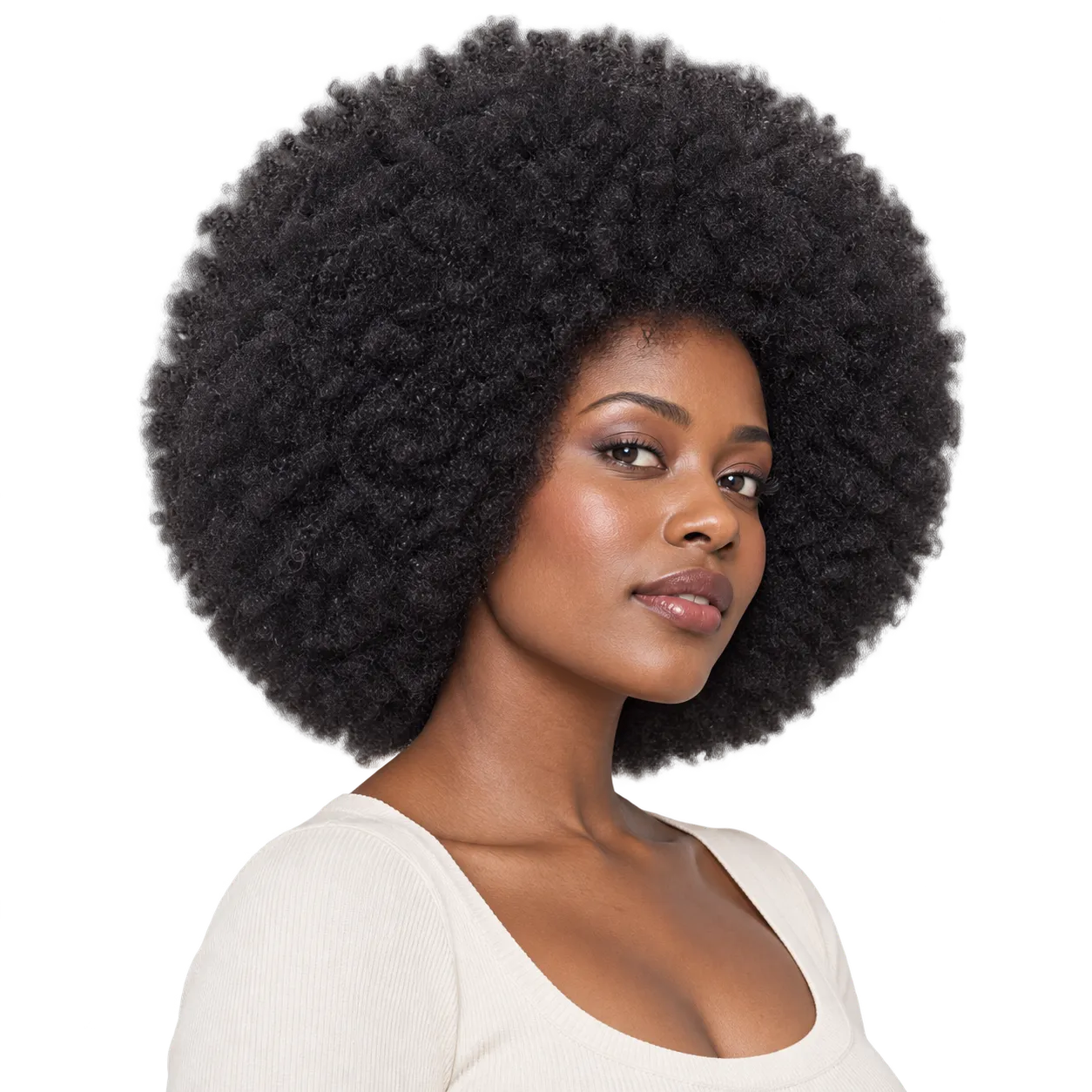
The sculpted spherical afro is a specific full-Afro silhouette rather than simply any rounded natural style. Substantial coily length is lifted away from the scalp and distributed outward so the hair forms a broad three-dimensional mass around the head.
The defining feature is geometric control of the outer silhouette. The perimeter is shaped toward an almost circular profile from the front and a rounded volume from the side, rather than following every irregularity of the natural growth pattern.
Afros became especially prominent in the United States during the Black-is-Beautiful and Black Power era of the late 1960s and 1970s, when wearing natural Black hair at visible scale carried strong cultural significance.
Afro picks and related wide-toothed tools help lift and separate dense coily hair outward. The final spherical appearance then depends on both that expansion and careful trimming of the outer surface.
“Sculpted spherical afro” is an editorial label used in this collection to distinguish this highly geometric full Afro from shorter cropped Afros and softer, more naturally irregular rounded Afros.
Style notes
- Hair Type Compatibility
- 1A1B1C2A2B2C3A3B3C4A4B4C
Estimates describe how closely defining features can be achieved with ordinary cutting and styling while preserving the natural curl pattern, assuming sufficient length. They are not personal suitability scores, promises, or eligibility guidance. Each segment is labeled for screen readers with its subtype and resolved score.
Examples
More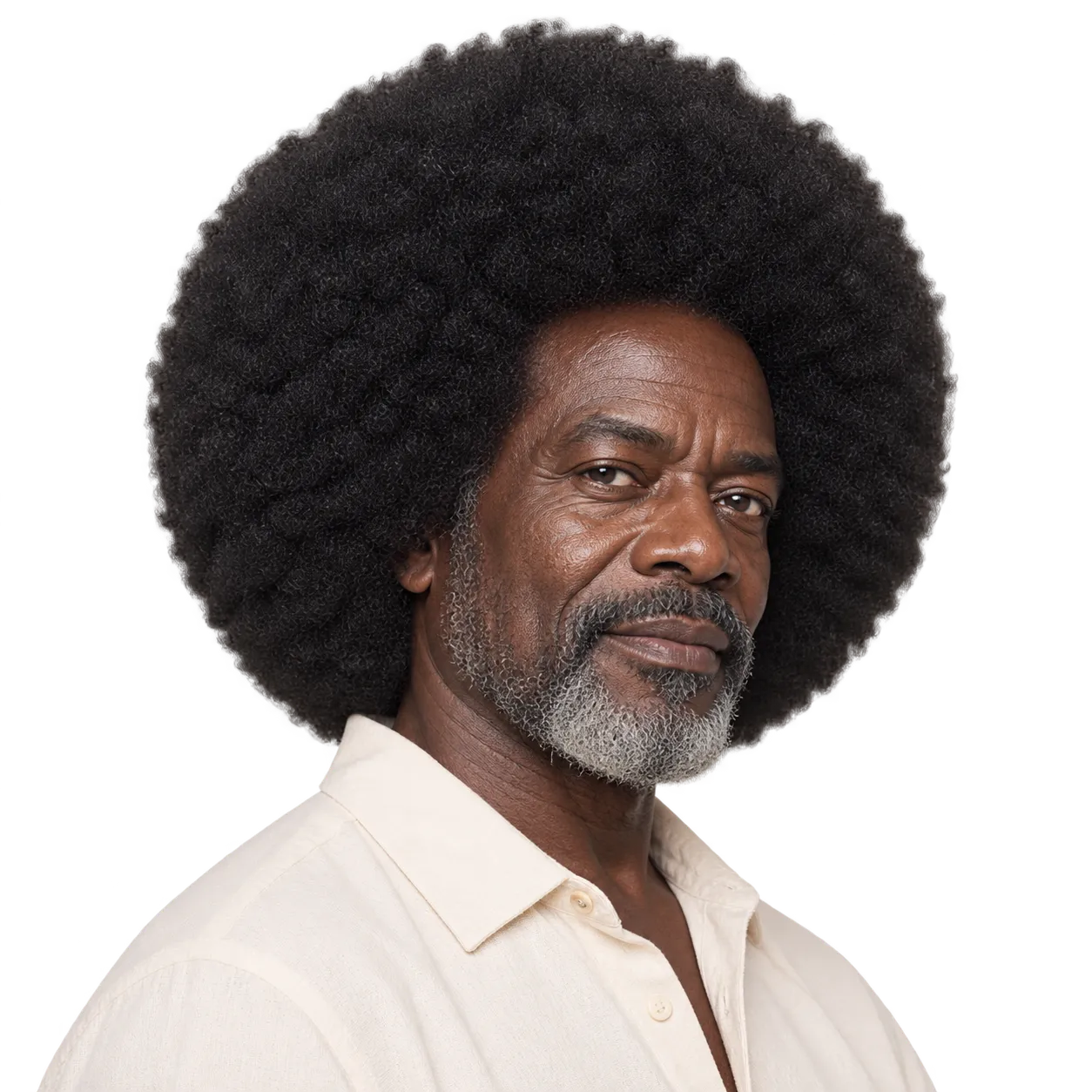
Variations
Choose the details
Near-perfect sphere
Maximizes symmetry and trims the outer perimeter toward an almost continuous circular outline.
Soft spherical shape
Retains the broad spherical mass while allowing slightly more natural irregularity at the outer edge.
The key decisions are overall diameter, how close to a true sphere the silhouette should be, how much natural surface texture remains visible, and how much length must be retained to support the desired volume.
- How large should the finished Afro read relative to your head and shoulders?
- Do you want an almost mathematically round silhouette or a softer rounded shape?
- Should the sides and crown carry equal visual radius, or should the top remain slightly higher?
- How much natural irregularity should remain visible around the perimeter?
- How frequently are you willing to pick, reshape and trim the style to maintain the spherical outline?
“I want a large sculpted Afro with a nearly spherical silhouette. Keep enough length and density to build real outward volume, pick it evenly from the scalp, and trim the perimeter into a controlled round shape rather than a short cropped Afro.”
What changes the result
Bring these variables
- The spherical silhouette depends on sufficient density and shrinkage resistance to support hair outward from the scalp rather than letting it collapse or hang.
- Picking changes the visible curl definition by separating and expanding the hair, so this style intentionally prioritizes silhouette over individually defined coils.
- The geometric perimeter requires periodic reshaping because uneven growth gradually disrupts the sphere.
- The style should be assessed in its fully picked-out dry state before perimeter trimming because shrinkage and expansion can change the final dimensions substantially.
- Very tight, dense coils are especially effective because they can maintain a large unsupported rounded mass. Looser patterns increasingly need manipulation or structural assistance and may still fail to reproduce the defining sphere.
- This entry describes the sculpted result rather than claiming every full Afro must be perfectly symmetrical; natural Afros also exist with softer and more irregular silhouettes.
Related Hairstyles
More
Sources reviewed
Strands of Inspiration: Exploring Black Identities through Hair · National Museum of African American History and Culture · reviewed
It’s More Than “Just” Hair: Revitalization of Black Identity · Smithsonian Center for Folklife and Cultural Heritage · reviewed
Look, Talk, Play · National Museum of American History · reviewed
Nathaniel Mathis Collection of Barbering and Beauty Culture · Smithsonian Institution · reviewed